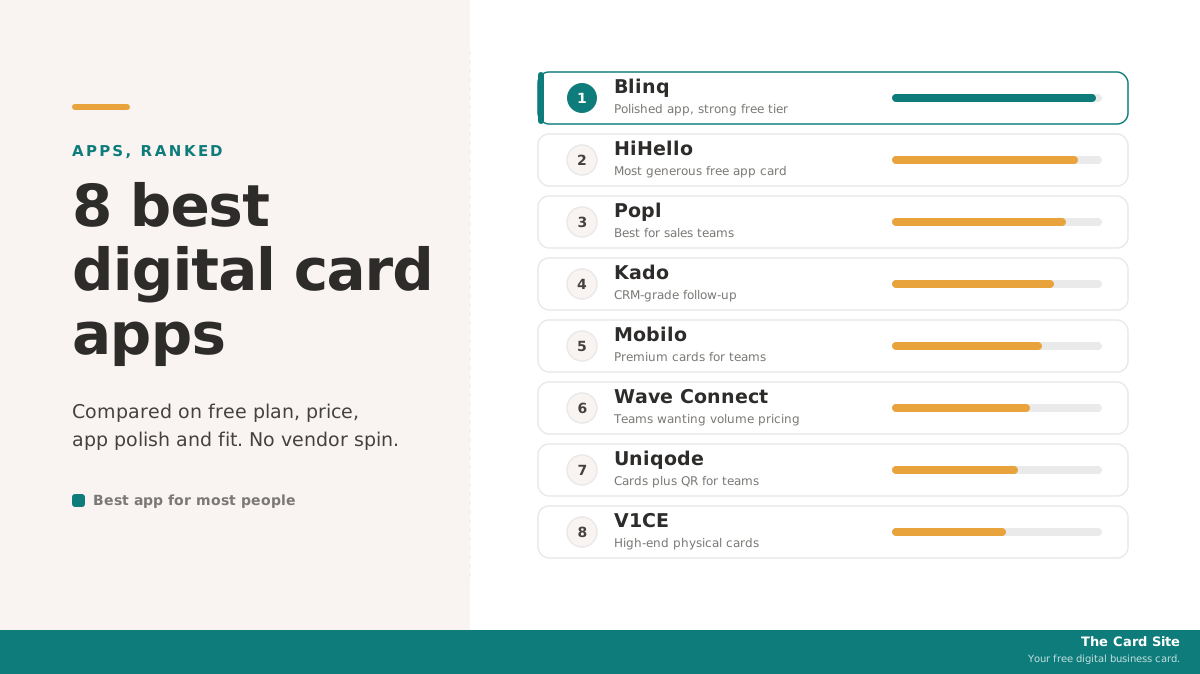
The phone in your pocket already does what a paper business card does, only better: it can hand someone your details in a single tap, keep them updated forever, and tell you who actually saved them. The only question is which app to run it through. The digital business card market is projected to grow from about $199 million in 2025 to over $331 million by 2031, according to Mordor Intelligence, and that growth has filled the App Store and Google Play with options that look almost identical from their marketing pages.
This guide ranks eight digital business card apps on merit: free plan, price, ease of setup, the app experience itself, and who each one actually fits. There is no fixed winner, because the best digital business card app for a solo freelancer is not the same one a 50-person sales team should standardize on.
Quick Answer: The Best Digital Business Card App for Most People
For most people, Blinq is the best digital business card app. It is app-first and individual-first, with a strong free tier, pricing published openly on its site, and a working card built in under five minutes. The app itself is polished, the default card looks professional without fiddling, and paid features like a contact scanner and AI enrichment are there when you grow into them. If you want a free app card with the most cards at no cost, HiHello is the better starting point. If you run a sales team that needs lead capture feeding a CRM, Popl is the stronger app.
The Card Site is reader-supported. Some links are affiliate links, so we may earn a commission if you buy, at no cost to you. It never changes our verdicts, and two apps below pay us nothing and still earn a recommendation.
What Makes a Good Digital Business Card App
Before the rankings, it helps to know what actually separates these apps, because the App Store screenshots all look the same. Five things matter most.
- A real free plan, not a trial. A free plan lets you run a working card forever. A trial expires and then asks for a card. The most generous free apps below let you ship a card today without paying anything.
- Pricing you can see. Some apps list every price on their site. Others route you to a sales call to find out what a team costs. The first kind lets you budget before you commit.
- The app experience. This is the part the comparison tables miss. How fast is setup, how clean is the card editor, how good is the contact scanner, and does sharing by QR, link, or Wallet just work? A digital business card app lives or dies on its mobile polish.
- Hardware versus app focus. Every app here works without buying anything, sharing by QR, link, or Apple and Google Wallet. Some also sell NFC cards for tap-to-share; others treat hardware as optional. If you only share by QR or link, hardware barely matters.
- Team and CRM depth. If several people will use it, you want shared templates, admin controls, and captured contacts flowing into a CRM. If you are one person, that depth is weight you do not need.
Keep these five in mind; they explain most of the verdicts below.
The 8 Best Digital Business Card Apps at a Glance
Here is the short version before the detailed breakdowns. Every app below is a real, third-party product, ranked by how well it fits the typical person searching for a digital business card app.
| App | Best for | Starting price | Free plan | iPhone + Android |
|---|---|---|---|---|
| Blinq | Most people | Free; Premium ~$10/mo | Yes (2 cards) | Yes |
| HiHello | A free app card | Free; Pro ~$8/mo | Yes (4 cards) | Yes |
| Popl | Sales teams | Free; Pro ~$8/mo | Yes (1 card) | Yes |
| Kado | CRM-grade follow-up | Free; ~$2.50/user/mo | Yes | Yes |
| Mobilo | Teams wanting premium cards | Pro ~$3/mo | Free digital card | Yes |
| Wave Connect | Teams wanting volume pricing | Free; ~$59/user/yr | Yes | Yes |
| Uniqode | Teams that also want QR | Free; paid tiers | Yes | Yes |
| V1CE | Premium physical cards | Premium hardware | No | Yes |
A quick note on how the list is ordered. The top four are the app-first picks most people should consider: Blinq, HiHello, Popl, and Kado. The rest win on a specific angle, premium hardware, volume pricing, or a QR-code platform, that suits a narrower buyer. The detailed sections explain exactly where each one fits.
1. Blinq: The Best Digital Business Card App for Most People
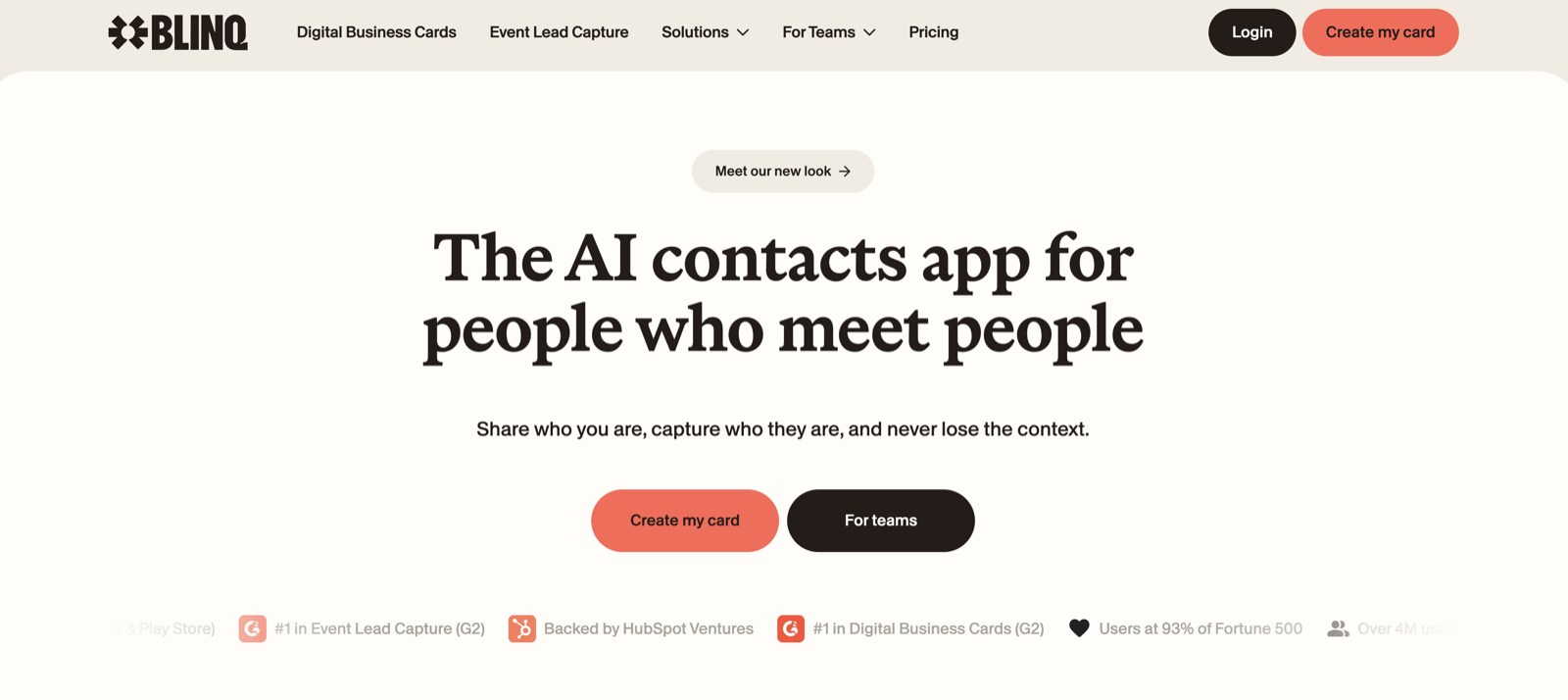
Blinq is the digital business card app most people should start with. It is app-first and individual-first, and it shows in the experience: you can build a card and share it without spending anything, and the free plan, two cards with unlimited sharing and Wallet support, is generous enough that plenty of solo users never upgrade. Setup takes under five minutes and the card looks professional by default.
Where Blinq earns its lead is polish and clarity. The card editor is clean, sharing by QR, link, Apple Wallet, or Google Wallet just works, and every price is listed on the site, so there is no sales call to find out what an upgrade costs. Premium adds a universal contact scanner that turns a paper card into a saved contact, an AI notetaker, and AI contact enrichment, the kind of features that matter once you collect contacts regularly.
Key features
- Free plan covering two cards, unlimited sharing, and QR or link sharing
- Apple Wallet and Google Wallet support out of the box
- Universal contact scanner and AI contact enrichment on Premium
- AI notetaker for logging context after a meeting
- Team admin, templates, and CRM sync on the Business tier
Pricing
| Plan | Price | Best for |
|---|---|---|
| Free | $0 | One person, two cards |
| Premium | ~$9.99/mo (or ~$7.33/mo annual) | Power users, extra cards |
| Business | ~$6.99/mo per card (or ~$4.99 annual) | Teams |
| Enterprise | Custom | Large organizations |
Pros
- ✓Polished app with a clean card editor
- ✓Strong free tier covering two cards and Wallet support
- ✓Pricing published openly, no sales call to see costs
- ✓Contact scanner and AI enrichment on Premium
Cons
- ✕Deeper CRM and analytics gated behind paid tiers
- ✕Physical NFC hardware is secondary to the app
- ✕Business tier requires a five-card minimum
Best for: solo networkers, freelancers, consultants, and small teams who want a polished app, a real free plan, and pricing they can see. If you came here from Popl, our Popl vs Blinq comparison breaks down every dimension. You can also try Blinq directly.
2. HiHello: The Best Free Digital Business Card App
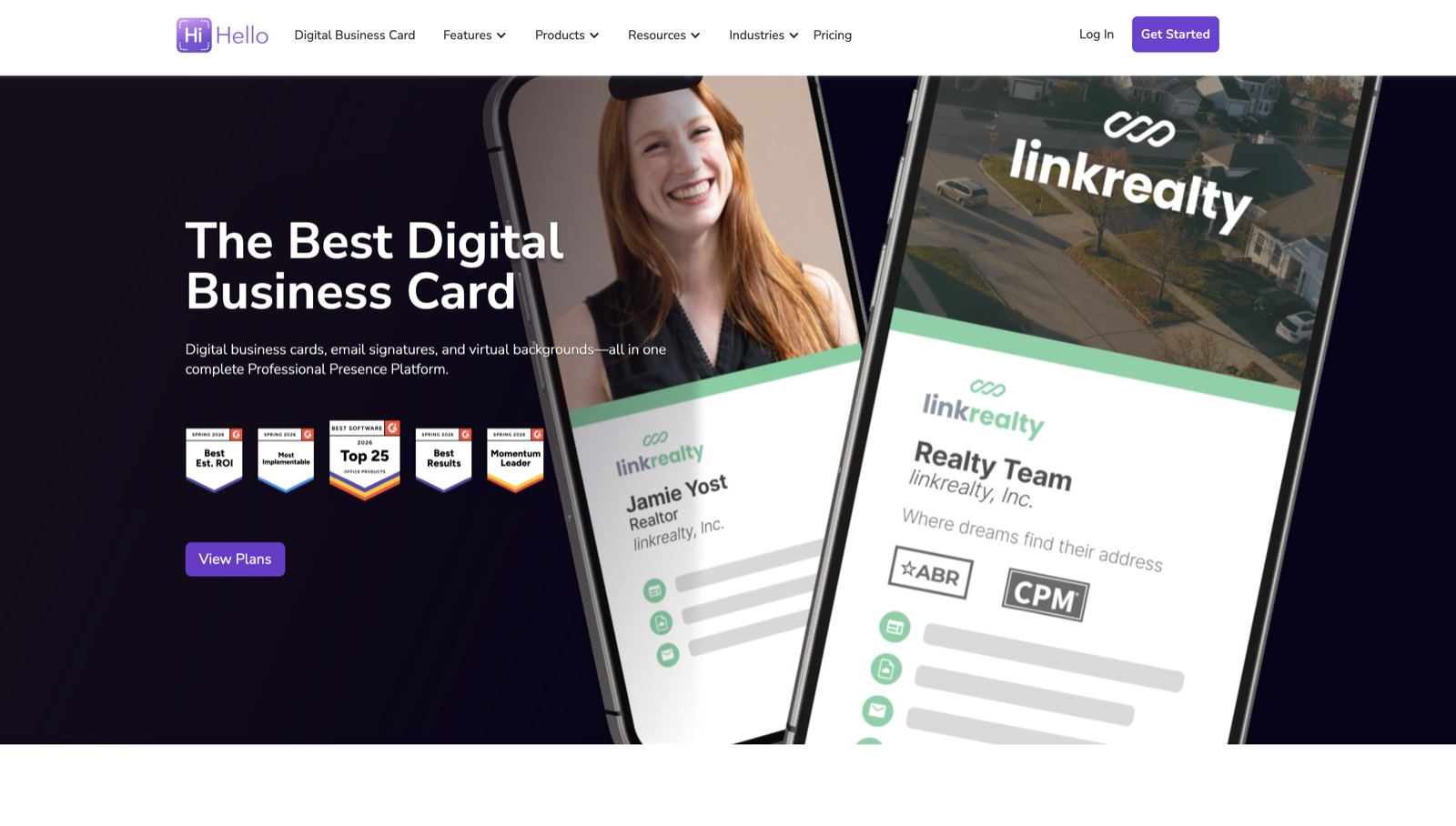
HiHello is the app to start with if your priority is a free digital business card, and it has the most generous free plan in the category. The free tier covers four digital cards, QR and widget sharing, a card scanner, and an email signature generator, all without paying or buying hardware. For a freelancer, student, jobseeker, or anyone testing the idea of a digital card, it is the easiest no-cost entry point.
It is worth being plain about one thing: HiHello runs no affiliate program, so this guide earns nothing from recommending it. It is here because on free-tier generosity and clean contact management it genuinely wins, and naming an app we do not profit from is part of keeping the rest of the list honest. Its main limit is that it is app and digital first, so it is not the pick if a premium physical NFC card is central to how you network.
Key features
- Most generous free plan of any app here (four cards)
- Built-in card scanner and email signature generator
- Apple Wallet and Google Wallet support
- Custom colors, analytics, and contact enrichment on Professional
- CRM integrations and SSO on the Business tier
Pricing
| Plan | Price | Best for |
|---|---|---|
| Free | $0 (4 cards) | A no-cost app card |
| Professional | ~$8/mo (or ~$6/mo annual) | One person, more cards |
| Business | ~$6/user/mo (or ~$5 annual) | Teams |
| Enterprise | Custom | Large organizations |
Pros
- ✓Most generous free plan (four cards)
- ✓Clean contact management and a built-in card scanner
- ✓Reasonable, published paid pricing
- ✓CRM integrations and SSO on Business
Cons
- ✕App and digital first, light on premium NFC hardware
- ✕Best free-tier features can change, so verify before relying on them
- ✕Less suited to hardware-led networking
Best for: anyone who wants a free, app-based card and does not need premium physical hardware. You can check out HiHello to see its current free plan.
3. Popl: The Best Digital Business Card App for Sales Teams
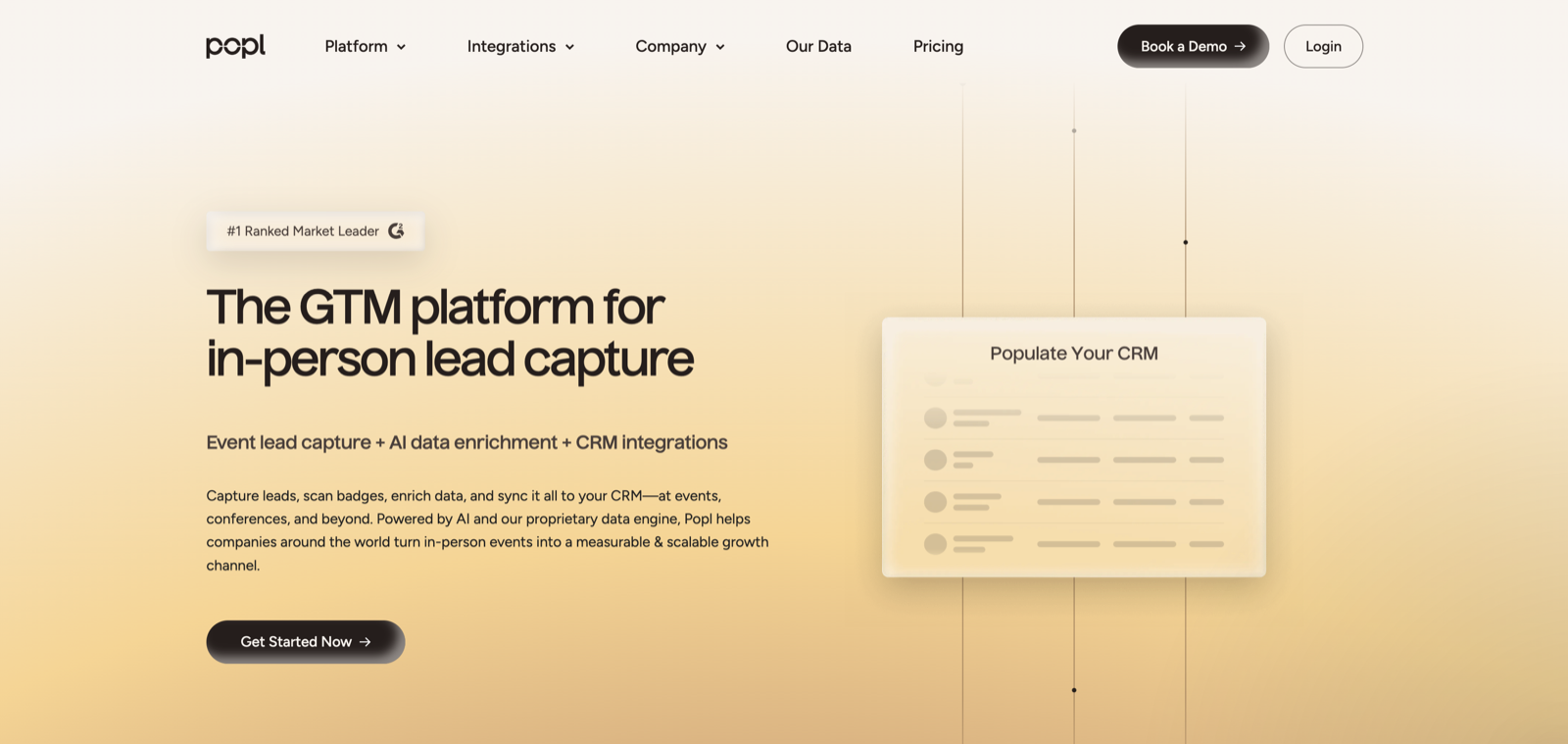
Popl is one of the most established names in NFC business cards, and its app is built around sales teams. You build a profile, then share it by tapping a Popl card or tag, scanning a QR code, or sending a link. The free plan gives one user a single card and basic sharing, and the paid plans add profiles, branding removal, and the lead-capture features that are the company's real focus.
The app shines when contact capture matters: tap a prospect, capture their details, and push the contact into a CRM, with team analytics a manager can act on. Individual pricing is published, Pro at about $7.99 a month (around $6.49 annual) and Pro+ at about $14.99 a month (around $11.99 annual), but the full team plan is quote only. For a solo user, the sales-team framing is heavier than you need; for a sales floor, it is the entire point.
Key features
- Mature NFC card and tag ecosystem with a wide hardware range
- Deep lead capture that syncs contacts into a CRM
- Team admin and analytics for sales organizations
- Published individual Pro and Pro+ pricing
- Apple Wallet and Google Wallet support
Pricing
| Plan | Price | Best for |
|---|---|---|
| Free | $0 (1 card) | Basic personal sharing |
| Pro | ~$7.99/mo (or ~$6.49 annual) | Individuals, contact capture |
| Pro+ | ~$14.99/mo (or ~$11.99 annual) | Custom lead-capture forms |
| Teams | Quote only | Sales organizations |
Pros
- ✓Mature, well-known app with a wide hardware range
- ✓Deep lead capture and CRM sync
- ✓Real team admin and analytics
- ✓Published individual Pro and Pro+ pricing
Cons
- ✕Team pricing is quote only, not published
- ✕Free plan is the most limited here (one card, no contact capture)
- ✕Heavier than a solo networker needs
Best for: sales teams and individual reps who need lead capture flowing into a CRM. You can explore Popl to see its current plans and hardware.
4. Kado: The Best App for CRM-Grade Follow-Up
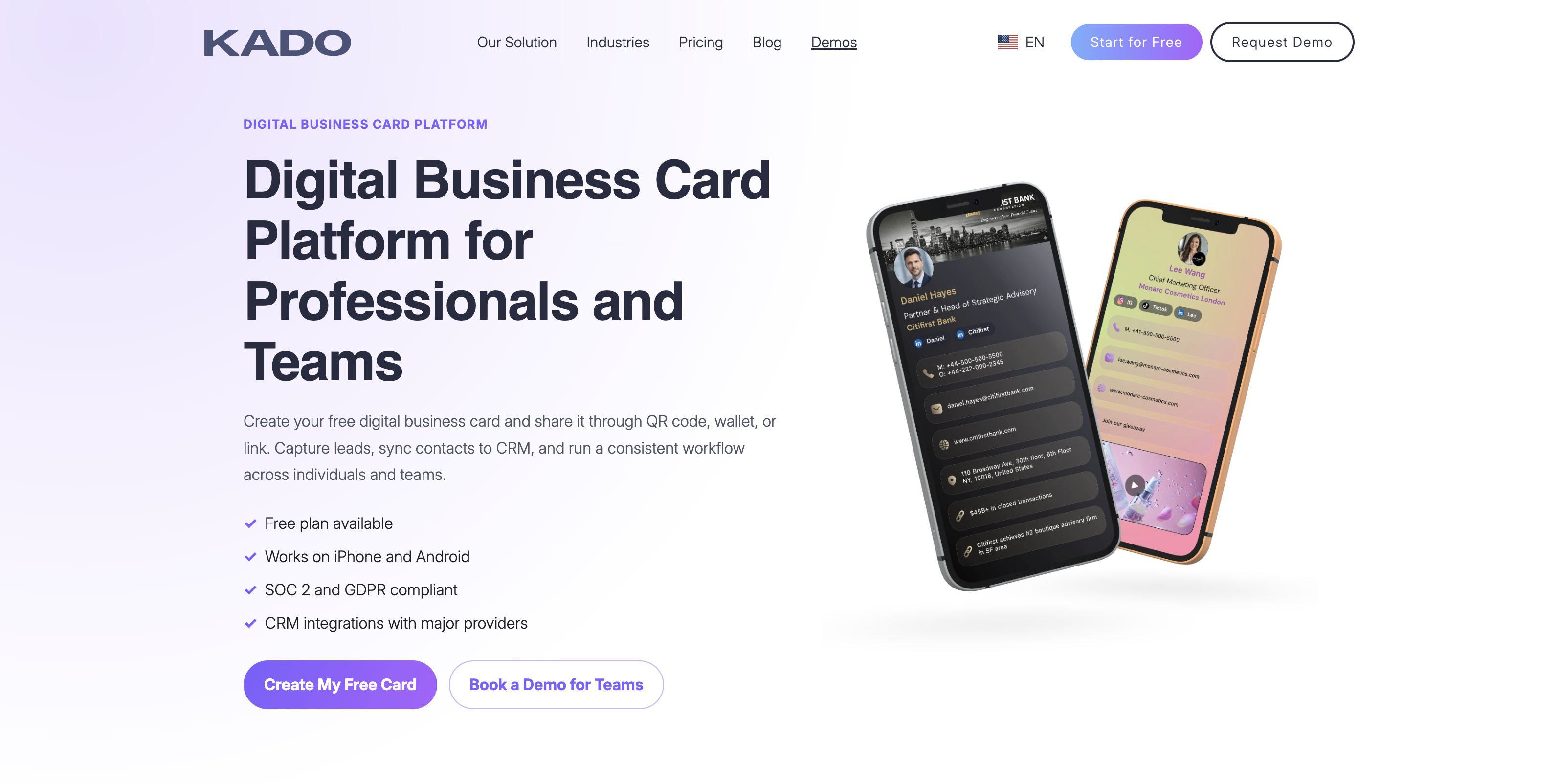
Kado is the app to reach for when what happens after the handshake matters as much as the share itself. It connects sharing, contact capture, and follow-up in one system: an AI scanner pulls details off a paper card, then notes, tasks, and CRM organization keep the conversation moving instead of letting a contact go cold. For anyone who works like a sales developer, where the follow-up is the job, that single workflow is a genuine advantage over apps that stop at handing over a profile.
Two things make it stand out. First, it is the cheapest team software in this guide, with a Networker plan around $2.50 a user a month and the most popular Business Developer tier around $4, both published openly. Second, it takes data seriously, with GDPR and SOC 2 compliance that teams handling contact data care about. Like HiHello, Kado runs no affiliate program, so this guide earns nothing from naming it. It is here because for follow-up workflow at a low price it genuinely wins, which is exactly the kind of pick that keeps the rest of the list honest. Its main limit is brand size, it is smaller than the leaders, and NFC hardware is made on demand rather than sold as a headline product.
Key features
- Sharing, contact capture, and follow-up connected in one system
- AI card scanner with notes, tasks, and contact organization
- CRM integrations on the Business Developer tier
- Cheapest team software here, with published per-user pricing
- GDPR and SOC 2 compliance
Pricing
| Plan | Price | Best for |
|---|---|---|
| Free (Networker Lite) | $0 | A solo card with capture |
| Networker | ~$2.50/user/mo | Small teams, branded cards |
| Business Developer | ~$4/user/mo | CRM, notes, tasks (most popular) |
| Enterprise | Custom | Large organizations |
Pros
- ✓Sharing, capture, and follow-up in one workflow
- ✓AI scanner with notes, tasks, and CRM organization
- ✓Cheapest team software here, pricing published openly
- ✓GDPR and SOC 2 compliance
Cons
- ✕Smaller brand than the leaders
- ✕NFC hardware is on demand, not a headline product
- ✕Pays this site nothing (a merit pick, not an affiliate)
Best for: individuals and teams who want sharing, contact capture, and CRM-grade follow-up in one app at a low price. You can check out Kado to see its current plans.
5. Mobilo: The Best App for Teams That Want Premium Cards
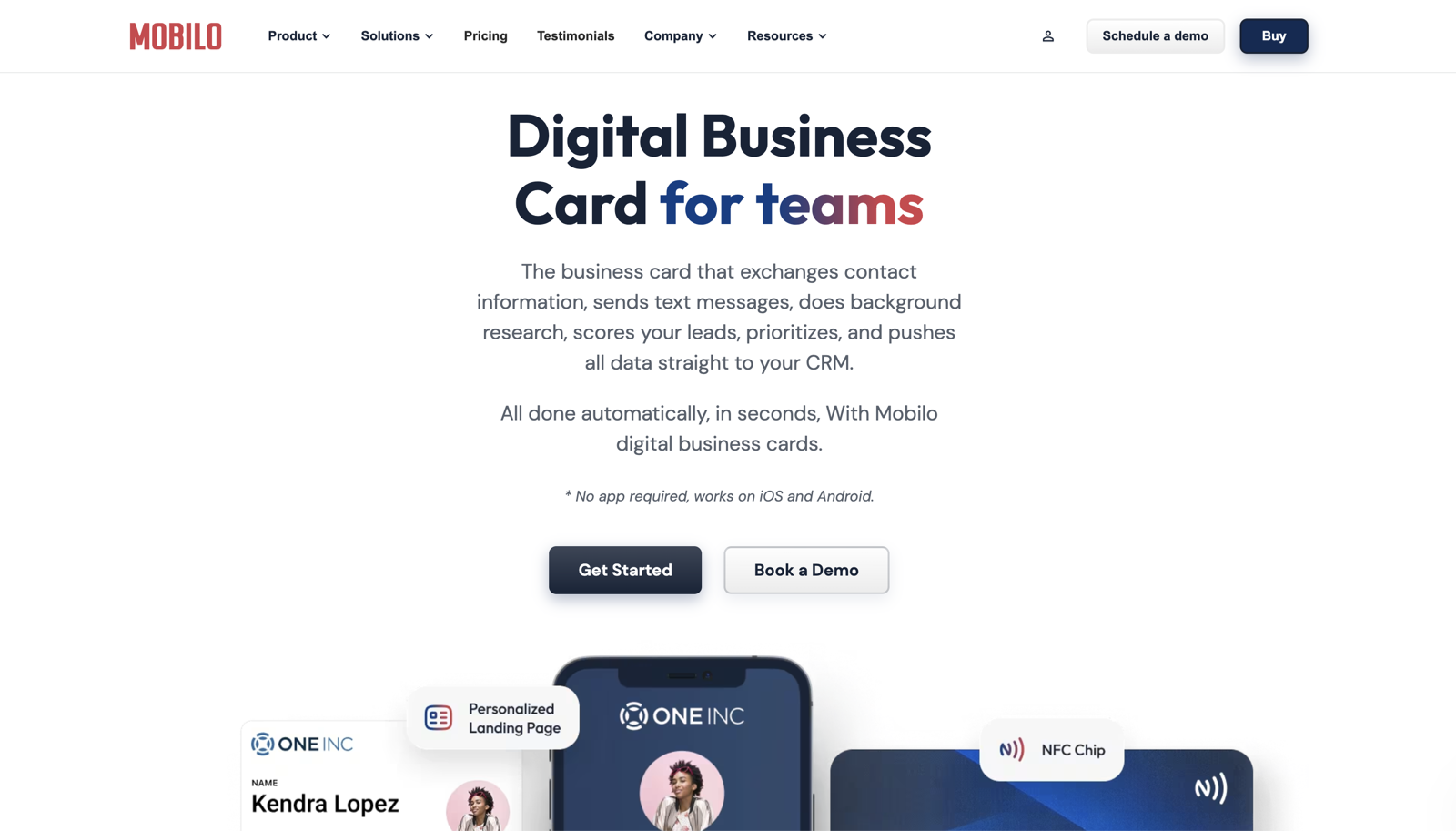
Mobilo is the dark-horse pick for teams that want premium physical cards paired with a cheap, published software subscription. Its app manages premium NFC cards, including metal and wood options, and its team plans add admin controls, CRM routing, and HR directory sync. The software is the cheapest of any app here, a Pro plan around $3 a month and team plans around $4 to $5 a month per user, and unlike Popl, the team price is listed openly.
The honest caveat is that Mobilo is hardware-led, so its value assumes you also buy one of its cards, and the team features are overkill for a single person who just wants a free digital card. There is a free digital card, but the company clearly wants you on hardware. For a team that cares about card quality and wants to see a price before committing, though, it is a serious contender.
Key features
- Premium NFC cards, including metal and wood, managed in-app
- Cheapest software subscription of any app here
- Published team pricing with admin controls
- HR directory sync and enterprise SSO on Business
- CRM routing for captured contacts
Pricing
| Plan | Price | Best for |
|---|---|---|
| Free | $0 digital card | Basic personal sharing |
| Pro | ~$3/mo | Individuals with a card |
| Teams / Business | ~$4 to $5/user/mo | Teams wanting admin + sync |
| Hardware | Premium cards, one-time | Quality physical cards |
Pros
- ✓Premium metal and wood NFC cards
- ✓Cheapest software subscription here
- ✓Published team pricing, unlike Popl
- ✓HR directory sync and enterprise SSO on Business
Cons
- ✕Hardware-led, so its value assumes you buy a card
- ✕Pricier overall than the app-first tools for one person
- ✕Team features are overkill for a solo user
Best for: teams and businesses that want premium cards with admin controls and a price up front. You can browse Mobilo to see its current cards and plans.
6. Wave Connect: The Best App for Teams That Want Volume Pricing
Wave Connect is the pick for a team or sales org that wants an app and NFC card with analytics, but also wants the price to come down as headcount goes up. It covers the basics well, sharing by tap, QR, or link, analytics on who engaged, and free contact export so captured details are never locked in, and its per-user pricing for teams under 100 sits in line with Blinq, HiHello, and Popl at roughly $59 a user a year. Where it separates from that pack is volume: at 100-plus users it offers custom volume pricing, which few of the others publish, so a larger org can land below the standard per-seat rate.
The honest caveat is brand and overlap. Wave Connect is a smaller name in search than Popl or Blinq, and its sales-team positioning covers much of the same ground as Popl without the same recognition. For a solo user it is more than you need, and the volume advantage only kicks in at scale. But for a growing team weighing per-seat cost across vendors, it is a real contender the better-known apps do not always beat on price. Wave Connect runs an affiliate program, so a purchase through the link below may earn this site a commission at no cost to you; it does not change where the app sits on the list.
Key features
- App and NFC card with tap, QR, and link sharing
- Engagement analytics and free contact export
- Per-user team pricing in line with the major apps
- Custom volume pricing at 100-plus users
- Apple Wallet and Google Wallet support
Pricing
| Plan | Price | Best for |
|---|---|---|
| Free | $0 | Basic personal sharing |
| Teams (under 100) | ~$59/user/yr | Small to mid teams |
| Volume (100+) | Custom volume pricing | Larger orgs wanting discounts |
Pros
- ✓Analytics and free contact export included
- ✓Per-user pricing in line with the major apps
- ✓Custom volume pricing at 100-plus users
- ✓App plus optional NFC hardware
Cons
- ✕Smaller brand than Popl or Blinq in search
- ✕Sales-team angle overlaps Popl without the recognition
- ✕Volume advantage only matters at scale
Best for: growing teams and sales orgs that want an app plus NFC card and volume pricing as they scale. You can explore Wave Connect to see its current plans.
7. Uniqode: The Best App for Teams That Also Want QR Codes
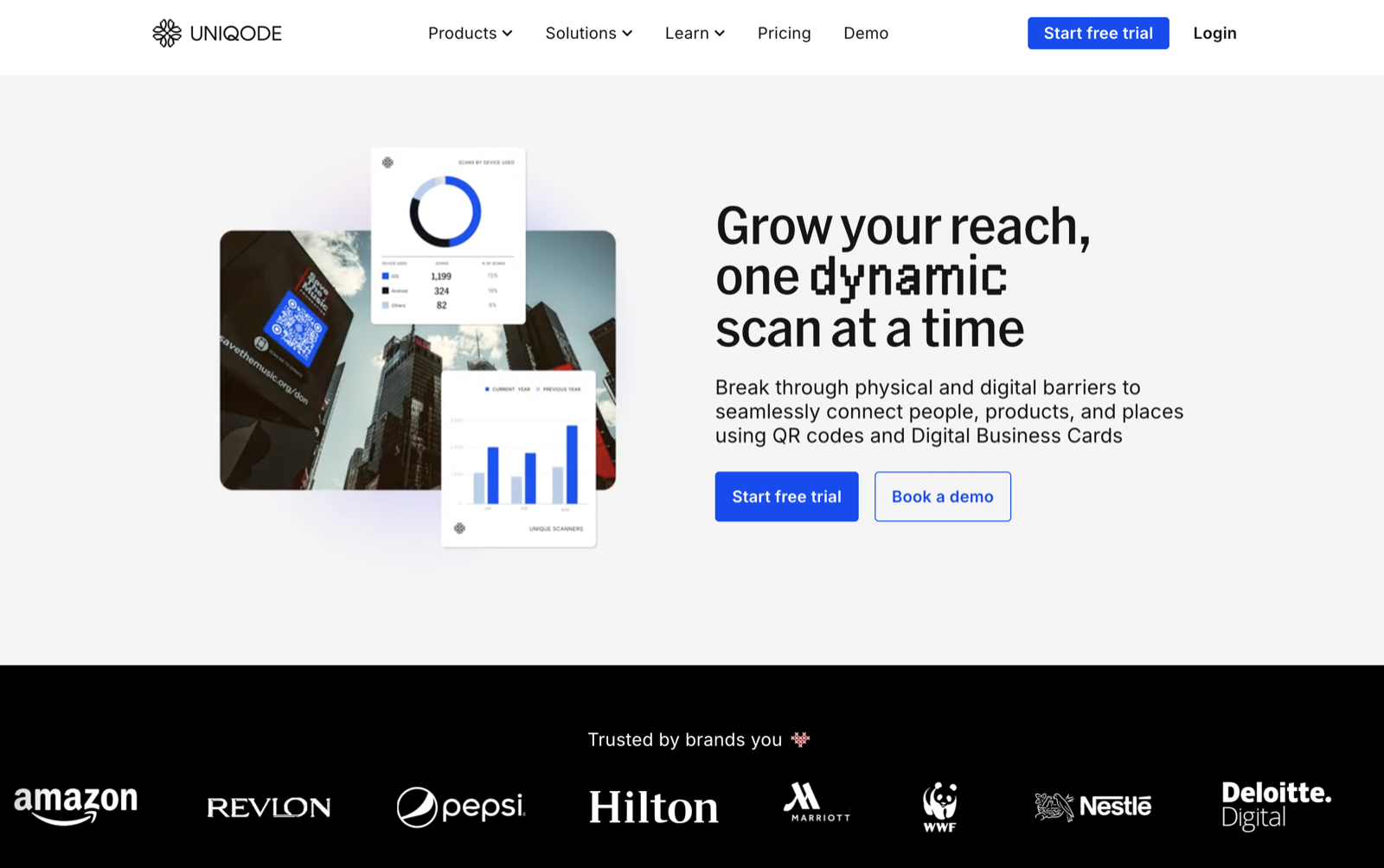
Uniqode (formerly Beaconstac) takes a different angle: the digital business card is one feature inside a broader QR-code platform. If you are equipping a team and also want QR-code marketing, dynamic QR campaigns, and analytics alongside the cards, Uniqode handles all of it in one app, with published pricing and a free tier to start on. It is the most platform-oriented pick here.
The honest caveat is focus. Because the card sits inside a larger QR and enterprise toolset, Uniqode is more than a solo networker needs, and its positioning leans enterprise. For one person who just wants a clean card, Blinq or HiHello is a lighter fit. But for a team that wants cards and QR campaigns managed together with admin controls, it is a genuine option the pure card apps do not match.
Key features
- Digital business cards inside a broader QR-code platform
- Dynamic QR codes, campaigns, and analytics
- Team admin controls and bulk card management
- Published pricing with a free tier
Pricing
| Plan | Price | Best for |
|---|---|---|
| Free | $0 | Trying cards and QR |
| Paid tiers | Published per feature (verify live) | Teams, QR campaigns |
| Enterprise | Custom | Large organizations |
Pros
- ✓Cards and QR-code marketing managed in one app
- ✓Team admin controls and bulk card management
- ✓Pricing published openly with a free tier
Cons
- ✕Enterprise-leaning; more than a solo networker needs
- ✕The card is one feature inside a larger toolset
- ✕Verify current pricing before committing
Best for: teams that want digital cards and QR-code marketing managed together. You can look at Uniqode to see its current plans.
8. V1CE: The Best App When the Physical Card Matters Most
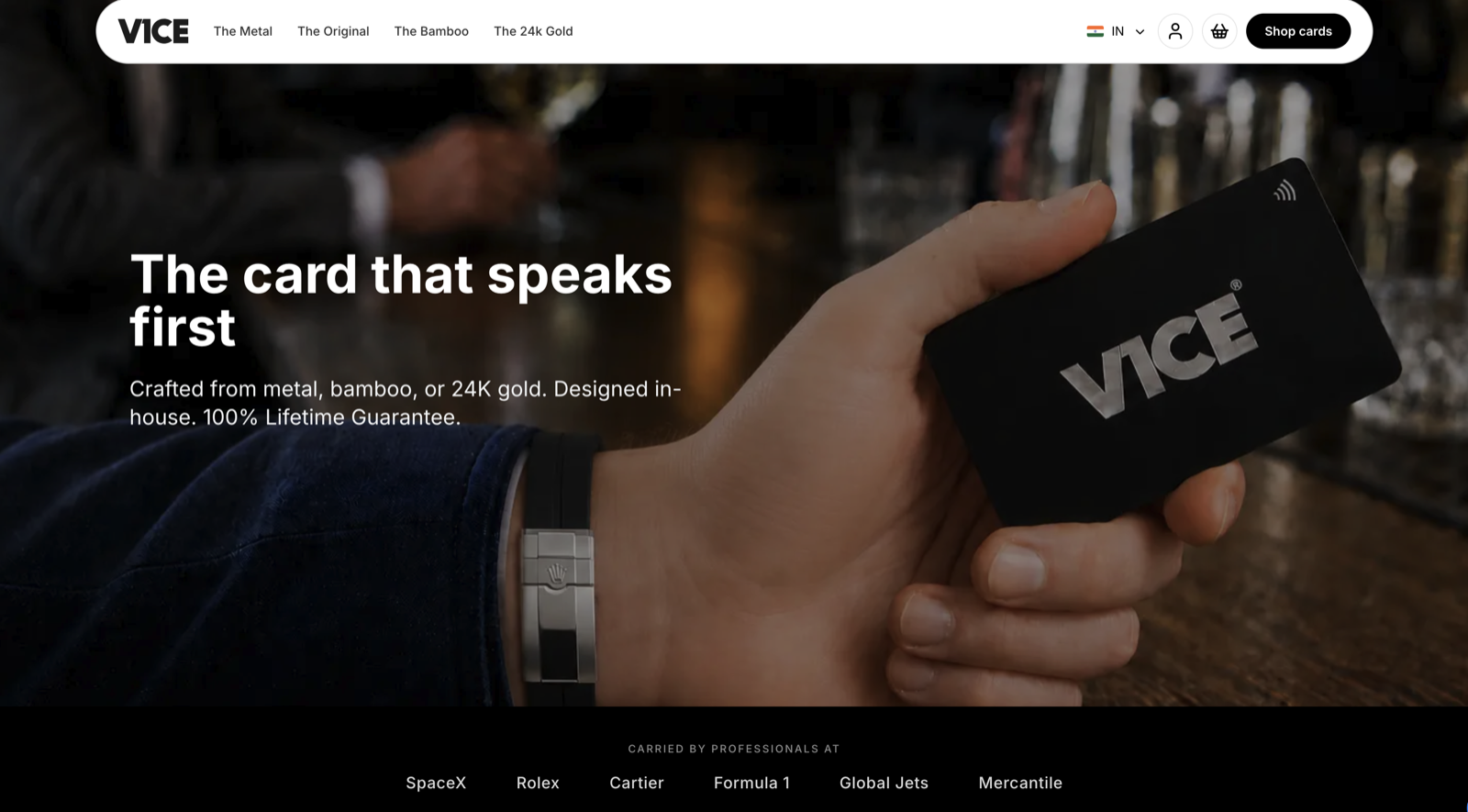
V1CE is the pick when the physical card itself matters as much as the app. It specializes in high-end NFC cards, including metal and custom-printed options, for buyers who want something that feels premium in hand, and its app manages the card and its analytics. If you want the most upscale card to hand across a table, V1CE is the natural step up from the app-first tools.
The trade-off is straightforward. V1CE is among the most expensive options in the category, which puts it out of range for budget buyers, and its team and CRM software depth is lighter than Mobilo's. It is a hardware-first choice, best suited to realtors, executives, and anyone who treats their card as a status object rather than a disposable.
Key features
- Premium metal and custom-printed NFC cards
- App and analytics for managing your card
- A card designed to look and feel high-end
Pricing
| Plan | Price | Best for |
|---|---|---|
| Hardware | Premium, mostly one-time (verify live) | High-end physical cards |
| App | App + analytics (verify if subscription) | Managing your card |
Pros
- ✓Premium metal and printed card options
- ✓Mostly one-time hardware cost, no heavy subscription
- ✓Strong fit when the card is a status object
Cons
- ✕Among the most expensive in the category
- ✕Lighter team and CRM software depth than Mobilo
- ✕Hardware-first, not for budget buyers
Best for: realtors, executives, and anyone who wants a premium physical card. You can browse V1CE to see its current card range.
How These Digital Business Card Apps Compare on Features
The table below lines up all eight apps on the dimensions that matter most when choosing.
| App | Free plan | App polish | Team / CRM | NFC hardware |
|---|---|---|---|---|
| Blinq | Yes (2 cards) | Excellent | Business tier | Optional |
| HiHello | Yes (4 cards) | Excellent | Business tier | Light |
| Popl | Yes (1 card) | Strong | Deep | Wide range |
| Kado | Yes | Strong | Deep (follow-up) | On demand |
| Mobilo | Free digital card | Strong | Strong | Premium |
| Wave Connect | Yes | Strong | Strong | Optional |
| Uniqode | Yes | Platform | Strong | QR-first |
| V1CE | No | Good | Light | Premium |
Digital Business Card App Pricing Compared
Pricing is where the differences get practical. Most of these apps publish their prices openly; Popl is the outlier for team buyers.
| App | Free plan | Cheapest paid plan | Billing model |
|---|---|---|---|
| Blinq | $0 (2 cards) | ~$7.33/mo (Premium, annual) | Monthly or annual, self-serve |
| HiHello | $0 (4 cards) | ~$6/mo (Professional, annual) | Monthly or annual, self-serve |
| Popl | $0 (1 card) | ~$6.49/mo (Pro, annual) | Self-serve; team is quote only |
| Kado | $0 | ~$2.50/user/mo (Networker) | Subscription, self-serve |
| Mobilo | Free digital card | ~$3/mo (Pro) | Subscription + hardware |
| Wave Connect | $0 | ~$59/user/yr (Teams) | Subscription, self-serve |
| Uniqode | $0 | Published paid tiers | Subscription, self-serve |
| V1CE | None | Premium hardware | Mostly one-time hardware |
Prices were verified against each app's official site at the time of writing. They change often, so check the live pricing page before you buy.
Which Digital Business Card App Should You Choose?
Use this decision matrix to match an app to your situation.
- Choose Blinq if you want the best all-round app: polished, free to start, transparent on price, and quick to set up. It is the best digital business card app for most people.
- Choose HiHello if your priority is a free app card. Its free plan covers four cards and it pays this site nothing, which is exactly why its place on the list is honest.
- Choose Popl if you run a sales team that needs lead capture feeding a CRM and want a wide NFC hardware range.
- Choose Kado if the follow-up matters as much as the share: you want sharing, capture, notes, and CRM organization in one app at the lowest team price, with GDPR and SOC 2 compliance.
- Choose Mobilo if you are equipping a team that wants premium physical cards with the cheapest published software, plus HR directory sync.
- Choose Wave Connect if you are scaling a team and want analytics, free contact export, and volume pricing that drops below the standard per-seat rate at 100-plus users.
- Choose Uniqode if you want digital cards and QR-code marketing managed together with admin controls.
- Choose V1CE if the physical card itself matters most and you want a high-end metal or printed card, budget allowing.
Frequently Asked Questions
What is the best digital business card app?
For most people, Blinq is the best digital business card app. It is app-first with a polished editor, a strong free tier covering two cards, pricing published openly, and a working card built in under five minutes. HiHello is the better pick if you want the most free cards, and Popl is stronger for a sales team that needs lead capture feeding a CRM. The best app depends on whether you are buying for yourself or a team.
What is the best free digital business card app?
HiHello has the most generous free plan, covering four digital cards, a card scanner, and QR sharing at no cost. Blinq is a close second with two free cards and Wallet support. Both are genuine free plans, not trials, so you can ship a working card today without paying. If a no-cost card is your only goal, start with HiHello and try Blinq if you want a more polished editor.
Do digital business card apps work on iPhone and Android?
Yes. Every app in this guide has native apps on both the App Store and Google Play, and all support adding your card to Apple Wallet and Google Wallet. NFC tap-to-share works on modern iPhones and most recent Android phones, and sharing by QR code or link works on any phone with a camera and a browser, regardless of platform.
Do I need an NFC card to use a digital business card app?
No. Every app here can share your card by QR code, link, Apple Wallet, Google Wallet, text, or email, none of which need hardware. An NFC card or tag only adds the tap-to-share gesture. Blinq and HiHello treat the physical card as optional and put the app first, while Popl, Mobilo, and V1CE lean harder into selling cards.
Is Blinq better than HiHello?
It depends on what you value. HiHello has the more generous free plan (four cards versus two) and is known for clean contact management, but it runs no affiliate program. Blinq has a slightly more polished default card and a richer paid feature set, including a contact scanner and AI enrichment, with pricing published openly. If free-tier generosity is the priority, choose HiHello; if you expect to pay and want the richer app, choose Blinq.
Are digital business card apps secure?
Reputable apps share only the information you choose to put on your card, and you control what each card shows. Team-focused apps like Popl, Kado, Mobilo, HiHello, and Uniqode add admin controls and, on higher tiers, enterprise features like SSO and directory sync for organizations with stricter requirements. Kado goes further with GDPR and SOC 2 compliance for teams handling contact data. As with any app, review the privacy policy and limit a card to the contact details you are comfortable sharing publicly.
Can I use a digital business card app for free forever?
Yes, with several of them. Blinq, HiHello, Popl, Kado, Wave Connect, and Uniqode all offer real free plans you can run indefinitely, not trials that expire. The free tiers differ in how many cards and which features you get, with HiHello the most generous at four cards. You only need to pay when you want extra cards, a contact scanner, team controls, or deeper analytics.
Which digital business card app is best for a sales team?
Popl is the strongest app for a sales team that lives in a CRM, with the most mature lead-capture motion and team analytics. Kado is the value pick when follow-up matters most, pairing capture with notes, tasks, and CRM organization at the lowest team price here. Mobilo is the better value if your team also wants premium physical cards and a published price, since Popl's full team pricing is quote only, and Wave Connect is worth a look for a larger org that wants volume pricing at 100-plus users. For a lighter team that prefers self-serve pricing, Blinq's or HiHello's Business tier covers shared cards and admin controls at a lower entry cost.
How is a digital business card app different from an NFC card?
The app is the software that builds, stores, and shares your card; the NFC card is optional hardware that adds a tap-to-share gesture. You can run any app in this guide with no NFC card at all, sharing by QR code, link, or Wallet. The NFC card is just one of several ways to hand someone your digital card, so the app is the part that matters most when choosing.
The Bottom Line on the Best Digital Business Card App
The best digital business card app comes down to who you are buying for. For most people, Blinq is the answer: a polished app, free to start, transparent on price, and quick to set up. If a free card is all you want, HiHello goes furthest with four free cards and earns its spot despite paying this site nothing. Sales teams that need CRM-fed lead capture should look at Popl, teams that want CRM-grade follow-up at the lowest price at Kado, teams that want premium cards with cheap published software at Mobilo, growing orgs that want volume pricing at Wave Connect, and buyers who want a high-end physical card at V1CE. There is no single best app, only the one that fits how you actually network. For the wider category beyond apps, our best digital business card guide covers hardware and use cases in more depth.
Last updated: May 2026. Pricing was verified against each app's official site at the time of writing; figures change, so check the live pricing page before buying.
Your free digital business card.
We are building a free digital business card you can share with a tap, no subscription and no sales call. Join the waitlist and we will let you know the moment it is live.
Join the waitlist →Free when it launches. No spam.